Solarfam
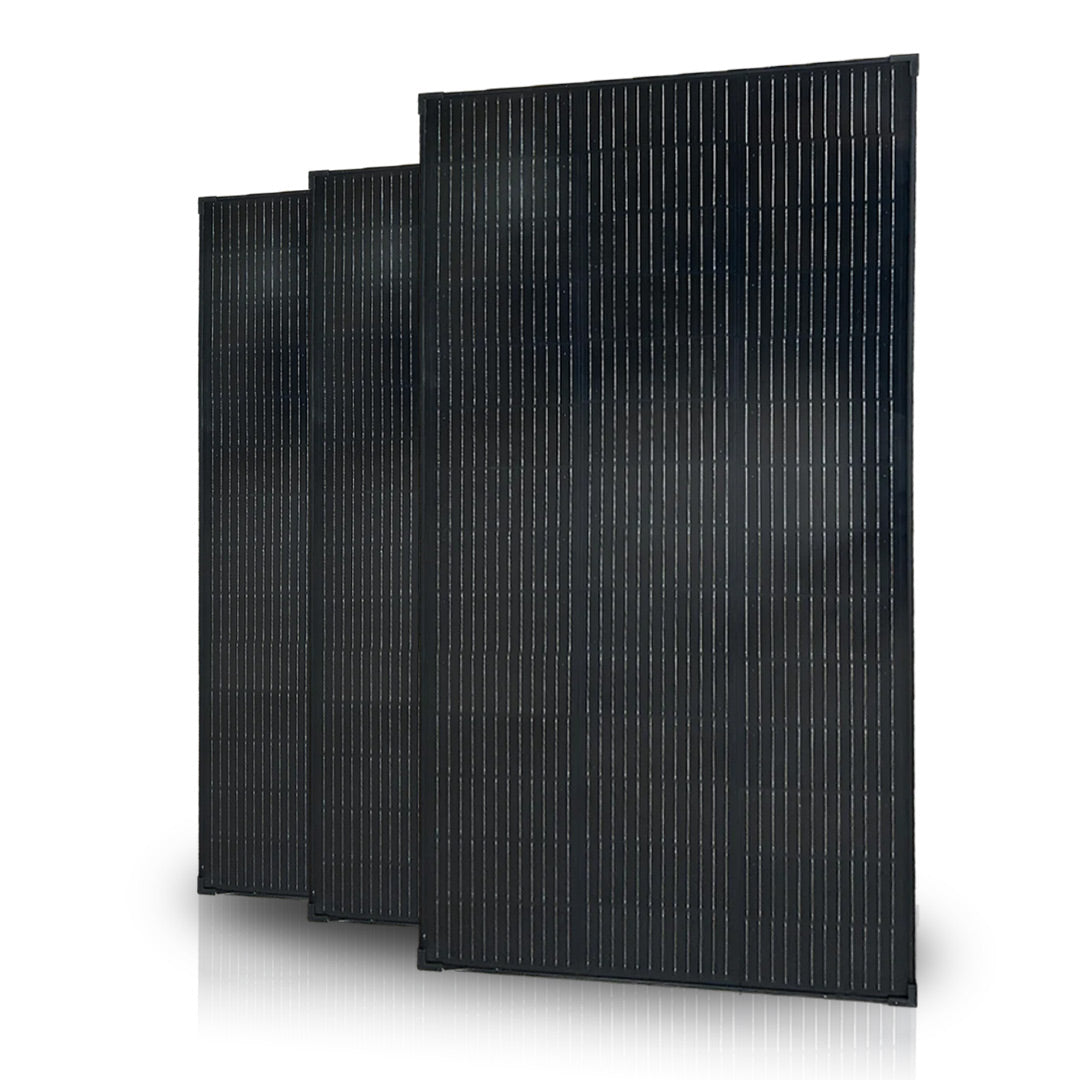
3 x SolarFam Monocrystalline 200Wp (600Wp)
3 x SolarFam Monocrystalline 200Wp (600Wp)
Couldn't load pickup availability
This bundle consists of 3 × SolarFam Monocrystalline 200Wp solar panels, totaling 600Wp of solar power. This is a large solar panel kit for campers, expedition vehicles, truck campers, boats, and other off-grid installations where ample roof space is available.
With 600Wp, you can recharge a significant amount of energy, especially in spring and summer. This bundle is interesting if you use heavier consumers via an inverter, such as laptop chargers, e-bike chargers, or electric cooking. In addition, the battery, inverter, cabling, fuses, and any other charging sources must be well-suited to the overall system.
Why this 600Wp bundle? ▾
- 600Wp total power: composed of 3 identical SolarFam 200Wp solar panels.
- Monocrystalline cells: suitable for high output on available roof space.
- High efficiency of 22%: efficient panel for campers, boats, and off-grid systems.
- Bundle discount: more affordable than purchasing the same panels individually.
- Interesting for larger installations: for example, for electric cooking, e-bike charging, or living in a camper.
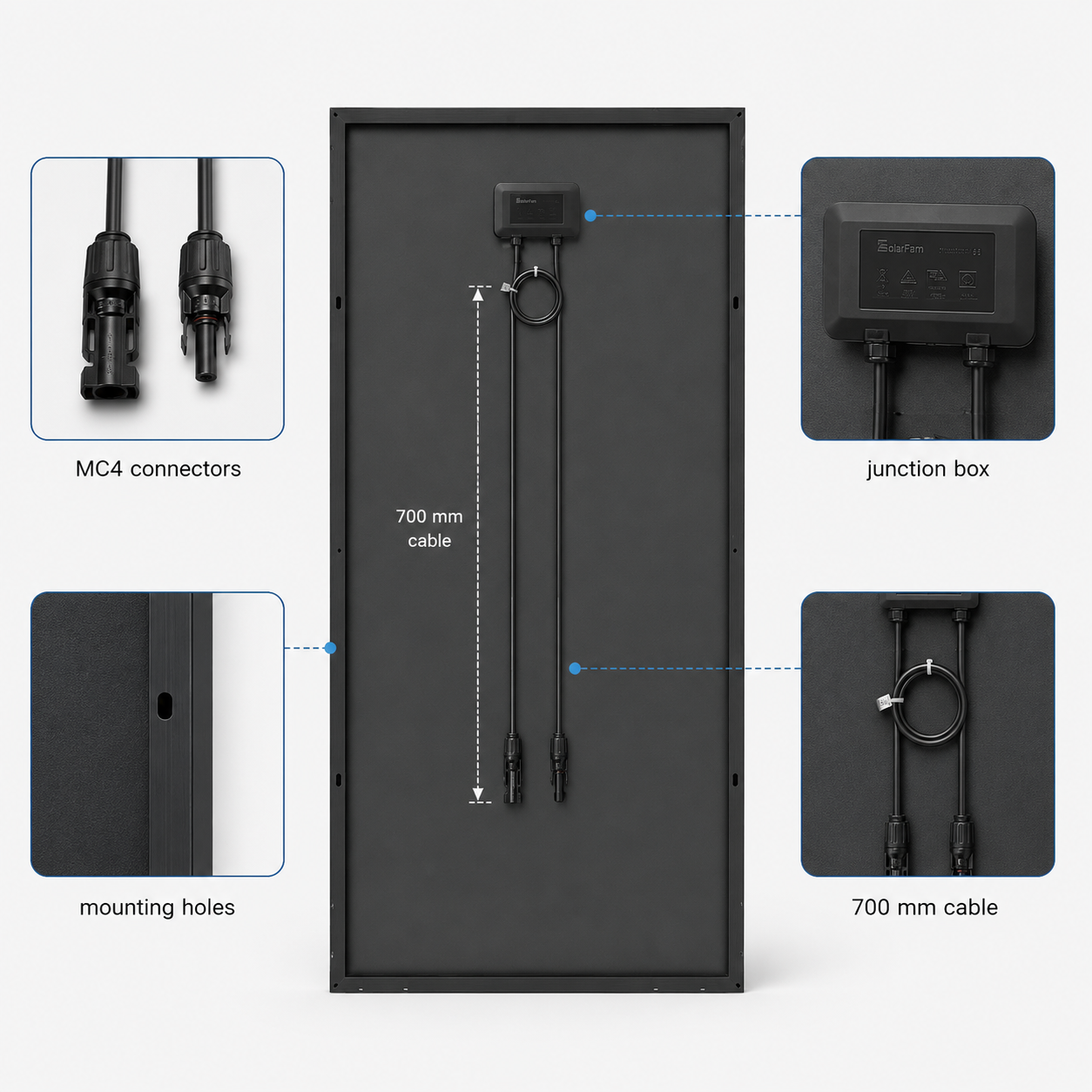
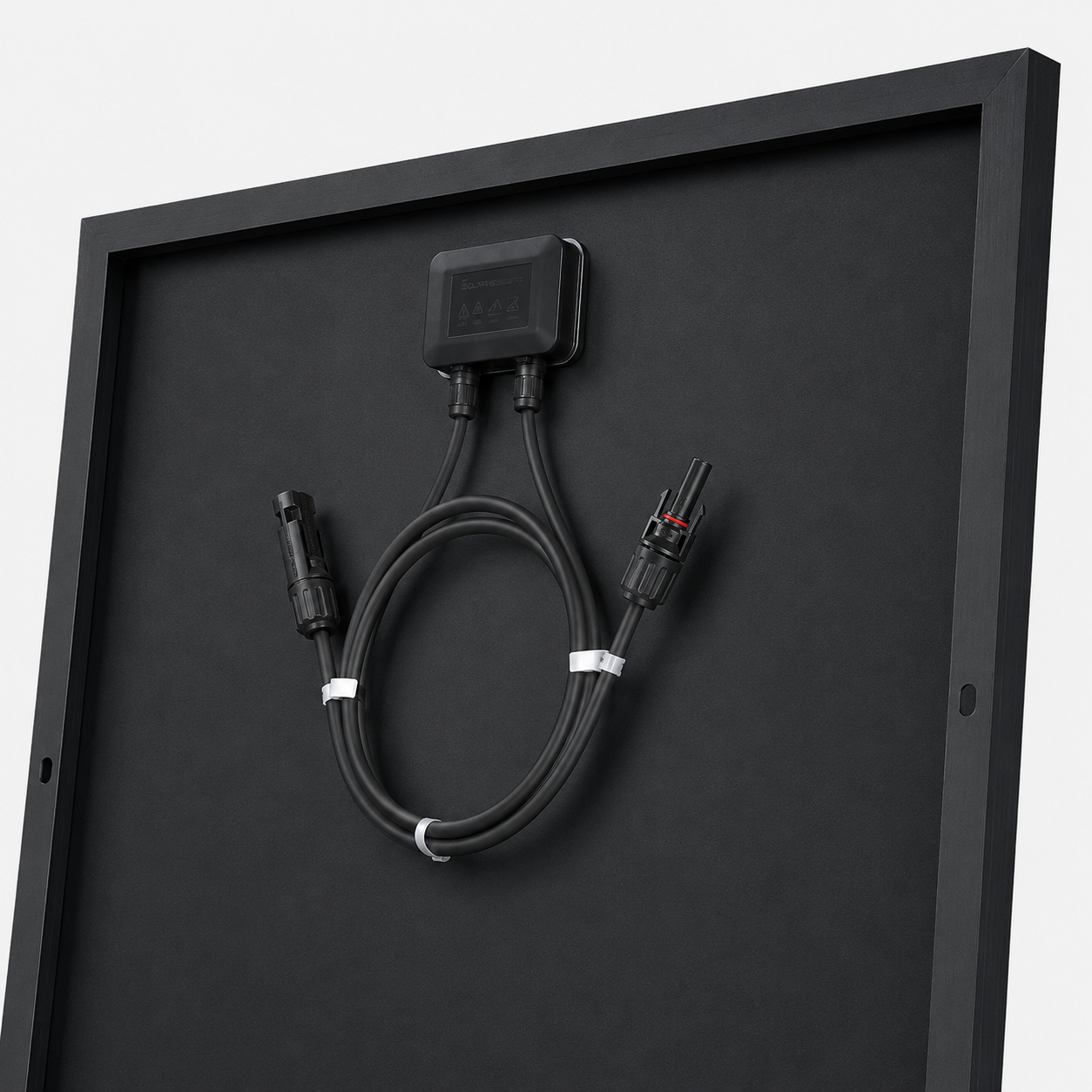
- MC4-compatible connectors: easy to combine with standard solar cables, MC4 splitters, and MPPT charge controllers.
Specifications & dimensions ▾
600 Wp
3 × SolarFam Monocrystalline 200Wp
200 Wp
SZ-200
Monocrystalline
22%
8.21 A
24.36 V
28.56 V
8.71 A
500 V
0 to +3%
700 mm / 2.5 mm²
MC4 / MC4 compatible
Aluminum frame / glass / EVA / backsheet
IP67
1530 × 670 × 30 mm
10.2 kg net
approx. 30.6 kg net, excluding mounting material
-40°C to +80°C
5 years
Three panels of this size do not easily fit on every camper roof. On a standard long panel van camper, it might sometimes fit, especially with few roof hatches or other accessories. This bundle is particularly interesting for larger or more unique camper conversions, such as truck campers, expedition vehicles, or spacious off-grid projects.
How to connect 3 panels? ▾
For this bundle of 3 × 200Wp, we advise connecting the panels in series. Connecting three panels in parallel is not advisable for these panels, as the current could then become too high for standard MC4 connectors and solar cables.
Recommended: three panels in series
In series connection, you connect the positive cable of one panel to the negative cable of the next panel. The two remaining cables go indoors via a single solar cable set, towards the MPPT charge controller.
- Advantage: higher voltage towards the MPPT.
- Lower current through the solar cables than with parallel connection.
- You usually only need 1 solar cable set for the cables going indoors.
- This connection makes sense for both 12V and 24V systems, provided the MPPT controller is suitable for the panel voltage.
Why not parallel?
One panel has a short-circuit current of 8.71A. With three panels in parallel, the current can rise to approximately 3 × 8.71A = 26.13A. Due to tolerances, conditions, and safety margins, you then get too close to the limit for standard MC4 connectors. Therefore, we do not recommend parallel connection for this bundle.
Which charge controller fits 3 × 200Wp? ▾
For this bundle, we recommend the Faraday SmartSolar MPPT 100/40 for a 12V battery installation. This controller is a practical choice for this set. Because 600Wp is slightly above the maximum recommended PV power for this controller at 12V, the controller may clip at peak moments. In practice, this mainly happens with plenty of sun and favorable conditions.
If you use a 24V battery installation and connect the panels in series, the Victron SmartSolar MPPT 100/30 is a suitable choice. At 24V, this controller has sufficient charging power for this 600Wp bundle. When connecting three panels in series, always check the open-circuit voltage at the lowest expected temperature.
- Recommended for 12V: Faraday SmartSolar MPPT 100/40.
- Recommended for 24V: Victron SmartSolar MPPT 100/30, with appropriate panel wiring.
- Bluetooth app: convenient for viewing charging status, yield, and settings via your phone.
- Built-in display: direct reading without a phone.
- Suitable for multiple battery types: for example, AGM, gel, lead-acid, or LiFePO4.
Connecting MPPT to battery ▾
With 600Wp solar power, the battery side of the charge controller must be carefully implemented. The correct cable diameter and fuse depend on the chosen MPPT, the system voltage, and the cable length between the MPPT and the battery.
- For a 12V system with the 40A MPPT, we usually recommend 16mm² battery cable between the MPPT and the battery.
- For a 24V system with the 30A MPPT, the required cable diameter may be smaller, depending on cable length and installation structure.
- Place a suitable fuse as close as possible to the positive terminal of the battery or positive distributor.
- Use a suitable MIDI fuse holder.
- Use appropriate crimp cable lugs for the fuse holder, MPPT, and battery connection.
Other SolarFam 200Wp bundles ▾
Do you want less or more solar power? This SolarFam 200Wp panel is available as a single panel and as a bundle with multiple panels. When purchasing multiple panels at once, a bundle discount applies.
What is this bundle suitable for? ▾
This 600Wp bundle is suitable for larger camper installations where you want to utilize as much available roof space as possible. Think of larger panel vans, L3/L4 campers with few roof obstacles, truck campers, expedition vehicles, or projects where the panels are distributed over multiple applications.
- Suitable for basic consumers such as compressor fridge, LED lighting, water pump, fan, and phone chargers.
- Interesting for more regular laptop use, e-bike charging, or other consumers via an inverter.
- Can contribute to off-grid electric cooking, provided the battery, inverter, cabling, and protection are adapted accordingly.
- Suitable for people who want to stay off-grid for longer periods and maximize their roof area.
- Especially interesting for living in a camper or winter use, as you then want to have as much available solar area as possible.
- Can be combined with a complete off-grid system with lithium battery, MPPT, alternator charger, and/or shore power charger.
Mounting on camper roof ▾
Each panel is 670 mm wide. For mounting on a flat camper roof, you can use the black 68 cm spoilers. For panel vans, we usually recommend aluminum Z-profiles, set of 6 pieces per panel. These are often easier to install on a roof with ribs, curvature, or limited flat mounting surfaces.
- Flat roofs: plastic spoilers are mainly suitable for flat roofs, such as on (semi-)integrated campers or behind the alcove of an alcove camper.
- Panel lengthwise: preferably place the panel lengthwise on the camper roof, with the short sides facing forward and backward. The spoilers then guide the driving wind over the panel.
- Panel vans: for roofs with ribs or a slight curve, aluminum Z-profiles are usually more practical than long plastic spoilers.
- Boats: on a suitable flat deck, plastic corner brackets are often a practical mounting choice.
- Thoroughly degrease the roof and follow the instructions for the adhesive, sealant, and primer used.
- Use a suitable roof gland for the solar cables.
- Secure cables on the roof with UV-resistant adhesive pads and cable ties.
- Prevent cables from chafing, kinking, or moving loosely while driving.
- Insufficiently seal the roof gland or use incorrect sealant/primer for the roof material.
What else do you usually need? ▾
- Mounting: aluminum Z-profiles set of 6 pieces per panel for panel vans, black spoilers 68 cm for flat camper roofs or plastic corner brackets for boats
- Roof gland for solar cables
- Solar cable set 4mm² indoors
- Faraday SmartSolar MPPT 100/40 for a 12V battery installation
- Victron SmartSolar MPPT 100/30 for a 24V battery installation with appropriate panel wiring
- Battery cables, fuse holder, fuse, and cable lugs suitable for the chosen MPPT and cable length
Want to assemble a complete set? Send us a photo of your roof and your current electrical setup, and we'll think along with you practically.
Common mistakes ▾
- Connecting solar panels directly to a battery without an MPPT charge controller.
- Connecting three panels in series without checking the maximum input voltage of the 100V MPPT at low temperatures.
- Connecting three panels in series while one panel regularly receives shade and the others do not, without first carefully assessing the roof layout.
- Connecting three panels in parallel, which can cause the current to become too high for standard MC4 connectors.
- Using a too small or unsuitable charge controller without understanding that the controller may clip at peak moments.
- Using too thin battery cable between MPPT and battery.
- Not installing a fuse close to the battery on the positive side of the MPPT connection.
- Combining panels with different voltages or powers without checking the specifications.
- Leaving cables loose on the roof, with the risk of chafing, leakage, or cable breakage.
- Insufficiently sealing the roof gland or using incorrect sealant/primer for the roof material.
FAQ ▾
Which MPPT charge controller do you recommend for 3 × 200Wp?
For a 12V battery installation, we recommend the Faraday SmartSolar MPPT 100/40; the controller may clip at peak moments. For a 24V battery installation, the Victron SmartSolar MPPT 100/30 is a suitable choice. For three panels in series, always check the open-circuit voltage at the lowest expected temperature.
Does this bundle fit a standard camper van?
That largely depends on the roof layout. Three panels of 1530 × 670 mm require a lot of space. On an L3 or L4 camper van, it can sometimes fit if there are few roof hatches, vents, or other accessories on the roof. For larger camper conversions, expedition vehicles, or truck campers, this bundle is often more logical.
Should I connect the three panels in series or parallel?
We advise connecting these three panels in series. Three panels in parallel can generate too much current for standard MC4 connectors and solar cables. When connecting in series, always pay attention to the maximum input voltage at low temperatures for a 100V MPPT.
Can I cook electrically with 600Wp?
The solar panels can help recharge a lot of energy, especially in the summer. However, electric cooking demands a lot from the entire installation. You will also need sufficient battery capacity, a suitable inverter, good cabling, fuses, and preferably additional charging sources.
Is 600Wp suitable if I live in my camper van?
For living in a camper van, a large solar panel area is often wise, especially if you want to be off-grid during less sunny periods. However, winter yield remains limited. Therefore, combine this set with sufficient battery capacity and other charging sources, such as an alternator charger or shore power charger.
Which mounting brackets or spoilers fit these panels?
Because the panels are 670 mm wide, the 68 cm black spoilers fit well for mounting on a flat roof. For camper vans, we usually recommend the set of 6 aluminium Z-profiles per panel, as they are easier to install on roofs with ridges, curves, or limited flat mounting surfaces. On a suitable flat boat deck, plastic corner brackets are often practical.
Why three smaller panels instead of one large solar panel?
One large solar panel is often cheaper per watt, but on a camper roof, that is not always the best choice. With three smaller panels, you are more flexible in arranging your roof, for example, around roof hatches, vents, or rails. Additionally, smaller panels are often stiffer due to their shorter and narrower frames than large household panels, making them less vulnerable in practice on vehicles.
Deel