Xenteq Isolation Monitor 230Vac 25A
Xenteq Isolation Monitor 230Vac 25A
Low stock: 1 left
Couldn't load pickup availability
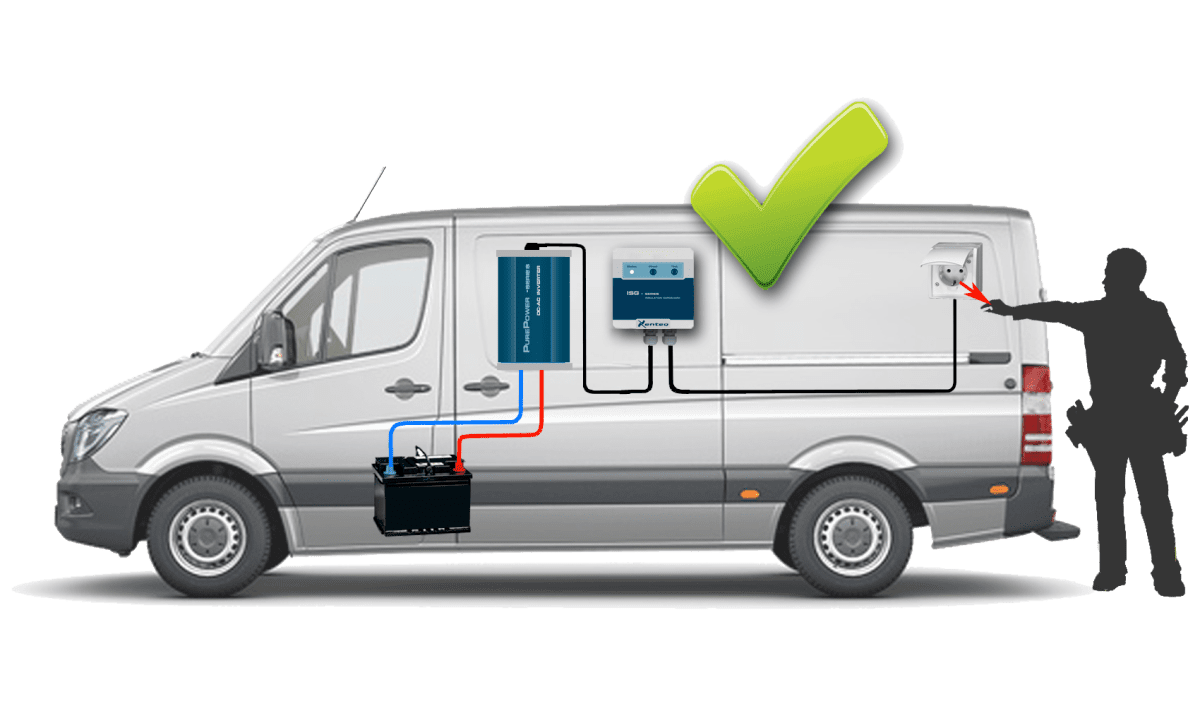
The Xenteq ISG 230-25 is an insulation safeguard for 230V installations with an IT power system (such as with an inverter or generator). The device continuously monitors the insulation resistance and automatically switches off the 230V output in case of a fault from phase or neutral to earth.
What is an insulation safeguard?
In a residential home, personal safety is ensured by a residual current device (RCD) and an earth pin. An inverter/generator often creates an isolated neutral system (IT system). This requires a different approach.
What exactly does the ISG 230-25 do?
- Continuously monitors the insulation resistance of the 230V system.
- Provides a pre-warning when insulation decreases (alarm 1).
- Switches off the output as soon as the insulation resistance becomes too low (alarm 2).
According to the manual, the insulation monitor replaces the RCD in an IT system, where an RCD cannot/should not be used.
This product concerns personal safety for 230V from an inverter/generator. Always have installation performed by a qualified technician.
When do you need this in a camper?
- If you generate 230V with an inverter or combi (e.g. Victron MultiPlus) and you also route the 230V “outwards” or to multiple outlets.
- If you have an isolated 230V system and want to ensure personal safety technically.
- If your installation operates on both shore power and inverter power and you want to separate them cleanly.
Why specifically the ISG 230-25 (25A)?
- Suitable for heavier 230V installations up to 25A (max. approx. 5750W).
- According to Xenteq, this model is also suitable for combi devices and systems with priority/transfer (such as inverter/charger combinations).
Connecting with Victron MultiPlus (combi inverter/charger)
In a camper with MultiPlus, you usually have 2 situations: inverter operation (230V from the battery) and shore power operation. The ISG 230-25 is designed to ensure personal safety with an isolated 230V system (inverter operation without shore power). As soon as shore power is active, the measurement is disabled via MAINS detection.
Important guidelines (practical)
- Place the insulation monitor between the AC output of the MultiPlus and your 230V distribution (circuit breakers / outlet groups).
- Preferably connect the insulation monitor as directly as possible to the MultiPlus (i.e., before other peripherals).
- For this 25A model, use 3-core 2.5 mm² mains cable for INVERTER and OUTPUT (according to Xenteq guideline).
- Lay an additional 2-core MAINS detection cable (0.75–1.5 mm²) and connect it to the same shore power supply as the MultiPlus (behind your RCD/circuit breaker after the CEE input).
Shore power present (also with PowerAssist)
When shore power is present, the ISG is in "mains present" mode and insulation measurement is disabled. This also applies if the MultiPlus uses PowerAssist (supplementing shore power with battery power).
- Personal protection then runs via the shore power RCD (campsite/pedestal) and your own shore power protection in the camper.
- As soon as shore power drops, the ISG restarts measurement (after self-test).
Important: N–PE coupling in MultiPlus (for correct operation of the ISG)
The Victron MultiPlus typically connects neutral and earth (N–PE) by default when the inverter is operating and no shore power is present. For correct operation of the Xenteq ISG, the 230V output in off-grid inverter operation must form an isolated neutral system.
- Therefore, disable the function in the MultiPlus settings that couples N–PE during inverter operation without shore power.
- After that, you can check off-grid whether the system is "isolated" (you will often measure approximately ~115Vac from L to PE and from N to PE, as an indication).
If you are unsure about the setting or the measurements, please contact us; incorrect settings can lead to unexpected behavior in your 230V network.
Note: when shore power is active, the shore power installation (pedestal + your camper input) must be equipped with a properly functioning earth leakage protection. The ISG is intended for personal safety with the IT system in inverter operation (without shore power).
Mounting & installation (brief and practical)
- Only by qualified technicians; and only one insulation monitor may be connected per electrical system.
- Mount as close as possible to the inverter/combi and keep the cable between inverter and ISG as short as possible.
- Mount on a flat, stable surface and prevent vibrations/shocks.
- IP66 housing: resistant to dust and water, but always mount neatly and without mechanical stress on the cable glands.
Test: Is your 230V output "isolated"?
According to the manual, you check this with a multimeter by measuring from L to earth and N to earth. In an isolated system, you will measure approximately 115 Vac on both (indicative). If this is not correct, the source may need to be adjusted (e.g., no fixed connection between N and earth).
Preventing overload
Xenteq advises installing a fuse on the output, appropriate to the maximum power of the model, to protect against overload.
Fuse value and type depend on your 230V distribution network (breaker panel, cable thicknesses, outlet groups). We are happy to assist you with this.
Operation, LED status and testing
After switching on, the ISG first performs a self-test. Only then is the output enabled. Allow for a delay of approximately 10 seconds.
Alarm levels
- Alarm 1 (pre-warning): at 46 kΩ (LED flashing red). Check the system for faults.
- Alarm 2 (shutdown): at 23 kΩ (LED red). Output is switched off.
LED status (summary)
- Flashing green: self-test active
- Green: all good, output active via inverter/generator
- White: shore power active, measurement disabled
- Flashing red: pre-warning (alarm 1)
- Red: output switched off (alarm 2)
- Flashing red/green: self-test unsuccessful (contact Xenteq)
Monthly self-test (recommended)
- Press Test → the ISG creates a fault and switches off.
- Then press Reset → self-test again, then active again if all is OK.
The ISG can reset automatically when the power source is re-energized, or manually via the reset button.
Specifications (ISG 230-25)
- Model: ISG 230-25
- Mains voltage: 180–250 Vac
- Frequency: 50/60 Hz
- Max. output power: approx. 5750 W
- Max. output current: 25 A
- Pre-warning (alarm 1): 46 kΩ
- Shutdown (alarm 2): 23 kΩ
- Suitable for combination with mains voltage: yes
- External signal on alarm 1: yes (n.o. or n.c.)
- Operating temperature: -25°C to +50°C
- IP rating: IP66
- Connections: input via cable gland M20, output via cable gland M20, MAINS detection via cable gland M20
- Weight: approx. 0.45 kg
Specifications according to Xenteq ISG-series manual / datasheet.
Why via Faraday Energy?
- We often combine this product with Victron MultiPlus installations and know where things can go wrong in practice (detection, sequence in 230V chain, distribution).
- Quick check of your diagram: "where exactly should it be placed" and "how to correctly connect MAINS detection."
- We help plan a neat 230V distribution: circuit breakers, outlet groups, and fuses suitable for your setup.
Need help with connection?
Send us the following, so we can assist you effectively:
- Which device generates 230V: MultiPlus model (e.g., 12/1600, 12/3000, 24/3000) or other inverter
- A photo or sketch of your 230V distribution (shore power → MultiPlus → groups/outlets)
- How you use the 230V: only indoors, or also outdoors/externally