
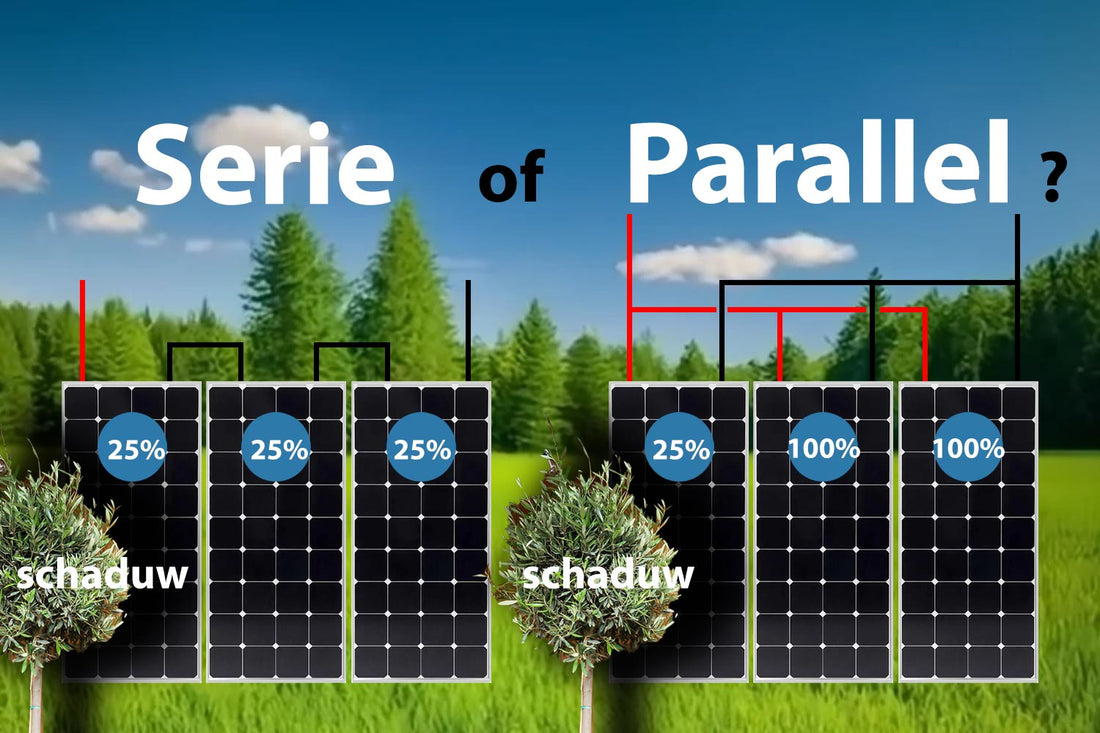
Connecting solar panels: series or parallel
Deel
When installing more than one solar panel on your camper, it is important to know how to best connect them. There are two main methods: series and parallel. Both have their own advantages and disadvantages. We will explain them to you so you can make an informed decision.
Series Connection of Solar Panels
When connecting solar panels in series, the positive terminal (+) of one panel is connected to the negative terminal (-) of the other panel. This creates a (long) string of solar panels, all connected via the positive and negative terminals.
Advantages:
- Higher Voltage: In series connection, the voltage of each panel is added up, while the current remains the same. This is useful if your inverter requires a higher input voltage.
- Fewer Cables: Because you have a higher voltage, you can use thinner cables. This is especially practical and also saves on costs.
- More Efficient over Long Distances: Higher voltage means less energy loss over long cables, which is more efficient for larger systems.
Disadvantages:
- Shade Sensitivity: If one panel is in the shade, it can negatively affect the performance of the entire string. This is because the current through all panels must be the same.
-
More Complex Fault Diagnosis: In case of a problem, it can be more difficult to identify the defective panel.
Parallel Connection of Solar Panels
When connecting solar panels in parallel, all positive and negative terminals of all panels are brought together.
Advantages:
- Insensitive to Shade: If one panel is completely or partially in the shade, the other panels will continue to operate at full power. This makes the system more reliable in varying weather conditions.
- Flexible Configuration: You can more easily combine panels of different types and capacities, as the voltage remains constant while the current increases.
Disadvantages:
- Higher Current: The current increases, which requires thicker cabling to prevent energy loss and heat generation. This is less convenient and also more expensive.
- Lower Voltage: Lower voltage means you may need an inverter with a lower input voltage, which can be less efficient over long cable distances.
The Faraday Glass 150Wp, 200Wp and 225Wp are equipped with monocrystalline PERC cells with a two-part design (with thirteen busbars per solar cell) that ensures the panel is much less sensitive to shade.
Which Method is Best for You?
Use Series Connection If:
- You have an inverter that needs a higher input voltage, such as Victron charge controllers.
- You need to cover a long distance with the cabling.
- You are sure that your panels will not often be in the shade.
Use Parallel Connection If:
- Your system is regularly exposed to (partial) shade.
- You want to use panels of different capacities with different output voltages.
- Your panels do not deliver too large a current. MC4 connectors can handle a maximum of 30A of current.
Conclusion
Choosing between series and parallel connection of solar panels depends on your specific needs and the conditions in which your system will operate. Series connection is ideal for higher efficiency and less cable usage, while parallel connection is better for reliability in varying weather conditions.
Do you need help choosing the right connection for your camper? Contact us and we will be happy to help!